what makes you sail due west and come back to where you started on flat earth
One of the reasons I described Greg Matloff equally the 'renaissance man of interstellar studies' in my Centauri Dreams book is the standing stream of ingenious ideas that he develops and delivers through papers and conference presentations. I found the holographic sail concept beneath fascinating, and would have referenced Bob Forrard myself if Greg hadn't already washed it in the text. These two must have been great to hear in conversation! Read on to learn how Greg, a physicist at New York City College of Applied science (CUNY) came up with the idea, a procedure that deftly blended science and fine art and may provide solutions to some of the more than intractable problems posed by Breakthrough Starshot. The writer of The Starflight Handbook among many other books (volumes whose pages have often been graced by the artwork of the gifted C Bangs), Greg has been inspiring this writer since 1989.
By Greg Matloff
Information technology was perhaps inevitable that I would exist asked to serve on the Advisor'due south Board of Yuri Milner'south Breakthrough Starshot, because of my long feel in the assay of interstellar travel techniques. According to Phil Lubin'south paper on this technology development project, a 50-lxx GW laser array mounted atop a southern hemisphere mountain would generate a beam that would be projected against an Earth orbiting ~i thou photon canvas for a period of minutes [1]. The sheet would be a major component of a ~1 gram wafer-scale spacecraft with a ~0.1-gram payload that would exit the axle later experiencing boilerplate accelerations of ~5,000 one thousand. The planned interstellar cruise velocity of the tiny spacecraft is ~0.2c and the voyage time to the Proxima/Alpha Centauri system is approximately two decades.
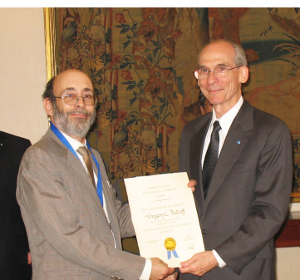
Paradigm: Gregory Matloff (left) beingness inducted into the International University of Astronautics by JPL'due south Ed Rock.
And then I attended the kickoff Starshot Advisors Meeting in August 2016 and left with a non-optimistic mental attitude. Yeah, it is possible to design very-high efficiency optical reflectors at the light amplification by stimulated emission of radiation wavelength (nigh 1 micron) to tolerate the enormous thermal load while maximizing dispatch [one]. Simply these devices tend to exist physically thick and massive.
A major problem turned out to be beam-riding canvas stability. The sail must be configured to remain in the beam, with its source located on the moving Globe and its terminus directed towards the Centauri organisation, for a period of minutes. Analysis discussed during the August 2016 coming together and afterward published revealed that a spherical sail curvature was the best approach to address the beam-riding stability event [ii]. Simply how would the sail maintain its required spherical curvature during the minutes-duration loftier-acceleration run?
Finally, rare ~1-micron interstellar dust grains impacting a sheet moving through the interstellar medium at ~0.2c pack quite a wallop [3]. And so if the spherical sail somehow survived dispatch, it would exist a good idea to straighten it mail service-acceleration to a flat sheet and reorient the spacecraft edge-on to the direction of travel.
Initially, I could think of no way to satisfy all of these requirements. And then I encouraged theoretical physicists associated with CUNY to recollect most means of increasing graphene reflectivity in response to an expected Request for Proposals (RFP) from the Starshot management squad. Because such a development is non impossible, I delivered several papers on the utility of reflective graphene in interstellar solar-photon sailing. In collaboration with other researchers, I also considered toned-downwardly space applications of wafer-scale spacecraft and less intense collimated ability beams. Even if the Starshot goal could not exist met, I hoped that some major technological advances might come from the decade-duration, $100 meg enquiry effort.
But the goals of robotically exploring the planetary systems of our nearest stellar neighbors on voyages requiring a few decades seemed too enticing to simply abandon. So when my partner, artist C Bangs, suggested that I reconsider holographic photon canvass coatings, a concept nosotros had collaborated on in 2000-2001, I agreed.
Bob Forward and Holographic Photon Sails
Long before C and I married, we were collaborators. She has generated chapter frontispiece art for most of my books, including The Starflight Handbook. During the summertime of 2000, my second year equally a NASA Faculty Swain at Marshall Spaceflight Center in Huntsville Alabama, we attended an International University of Astronautics symposium organized by Giancarlo Genta of Politechnico di Torino in Aosta, an Italian alpine city. My participation was concerned with extrasolar and interstellar solar-photon sailing, since NASA had funded my enquiry in the Heliopause Sail Technology Project, nether the direction of Les Johnson. C's role was to curate and hang an fine art bear witness, "Messages from Earth", in a medieval Aosta chapel. About 30 international artists contributed work presenting their conceptual message plaques that could be mounted on a solar-photon sail spring for the stars.
During the reception associated with the art testify, C was approached by the late Robert Forward. As many Centauri-Dreams readers will remember, Bob pioneered numerous approaches to interstellar travel during the last few decades of the twentieth century. When Bob reached into his wallet and withdrew a credit card, on-lookers expected that he might exist making a buy. Instead, he asked C how she would affix a message plaque to the canvas. She responded that a physical plaque (equally was done in Pioneer 10/11), a long-playing phonographic record (as was done in Voyager 1/2) or a calculator chip were possible approaches. Bob drew her attending to the white-light hologram on the credit bill of fare and expressed the opinion that a low-mass, thin-motion-picture show holographic plaque could contain a huge amount of information.
After the symposium, C returned to Brooklyn and I rejoined the Marshall canvas team. A few weeks afterward, while C was coincidentally visiting me in Huntsville, we were invited to a lecture by Bob. When Les Johnson introduced him, Bob pointed to C and said: "Fund that woman to do a prototype holographic interstellar message plaque".
So my small NASA University Challenge Grant through Footstep University, where I taught at the fourth dimension, was reconfigured to support the creation of the hologram. I received no bacon from this grant and then that the project could exist financed. Nosotros contacted the Center for Holographic Arts (and so located in Long Island Metropolis) and the rainbow hologram was completed at that facility with two sculpted figures and four line drawings past C with a transparency of the Apollo 17 image of Earth from deep infinite that is always visible and supports the holographic images.
We delivered one of the three resulting holograms to NASA Marshall in mid-2001. Some other was after purchased past a collector and donated to New York City College of Technology. We use the tertiary for display purposes.
There are seven 2D and 3D monochromatic images on this hologram, representing our solar system, probe trajectory and the human being course in a similar fashion to the Pioneer plaque. During the summertime of 2001, we showed it to many NASA and contractor employees. As function of the research effort associated with the plaque, we participated in simulated infinite-radiations tests of holographic wrapping paper samples. Holograms are manifestly immune to prototype degradation caused past intense solar flares [4-6].

Epitome: A view of the Rainbow Hologram created by C Bangs. The hologram contains six images. As the viewer moves from left to right the images transition from one frame to the side by side. On the extreme left side is a line drawing that places our abode solar arrangement on the edge of the Milky Mode Milky way and our planet, 3rd from our sun. The second frame is a line drawing of the female figure holding the payload of the solar canvas to demonstrate her size relative to information technology. The 3rd frame is the sculpted female figure. The fourth frame is the sculpted male person figure with his mitt raised in what is believed to be a universal greeting. The fifth frame is a line cartoon of the male figure. The terminal frame contains equations that draw the acceleration of the solar canvas that the hologram would hypothetically be traveling on. In front of all the images is an photograph of the total Earth visually demonstrating the dazzler of our habitation planet. Credit: C Bangs.
It became apparent to the team that Bob Forward was interested in other applications of holographic solar sail applications than message plaques. Equally discussed in Ref. 5, information technology is possible to modify the reflectivity of a white-light hologram with a slight rotation. Information technology is therefore conceptually possible to accelerate a solar photon canvas from Low Earth Orbit by rotating the canvas to reflect sunlight when the Sun is behind the spacecraft and transmit sunlight when the sail faces the Lord's day.
Current Technology Holography and Project Starshot
During 2017, C and I had several meetings with Dr. Martina Mrongovius, Creative Director of the NYC HoloCenter. The HoloCenter is the outgrowth of the Heart for Holographic Arts.
The art and science of holography has advanced at a rapid pace during the past few decades. Holograms every bit thin as 25 nm have been produced by an Australian-Chinese team [7]. Highly efficient wavelength-selective holographic filters and reflectors take been produced and evaluated [8-10].
Color of contemporary holograms displayed at the HoloCenter seems truthful to life. If the observer slowly changes position to view an experimental 3D holographic flick, activeness seems continuous with no breaks. Clearly, a vast corporeality of information can be stored on a single thin-movie hologram. According to the Wikipedia article on holography, thousands of images can be produced and stored per second. Martina reports in a YouTube video that some modern holograms contain x,000 holographic layers.
It no longer seems impossible to me that the Projection Starshot goals can be accomplished. One would use a holographic picture show and expose the image of a filter or mirror that is highly reflective in the laser's wavelength range. My colleague at Citytech, Lufeng Leng teaches optics. She is quite certain that a hologram of a spherical surface will carry optically similar a spherical surface. So the filter or mirror should ideally have a convex spherical shape, from the point of view of the observer (or laser).
If the holographic filter or mirror sail is sufficiently reflective to laser light, the thermal upshot should be resolvable. Since the hologram is a apartment canvas, information technology should be tolerant to high accelerations. If the spherical filter/mirror 3D epitome behaves as discussed in Ref. 2, the sail should self-right its position and remain in the moving laser beam. If a pair of tiny thrusters are mounted on the anti-laser face of the sheet, it should be possible to rotate the flat sail by 90 degrees later dispatch terminates to minimize damage by the interstellar medium.
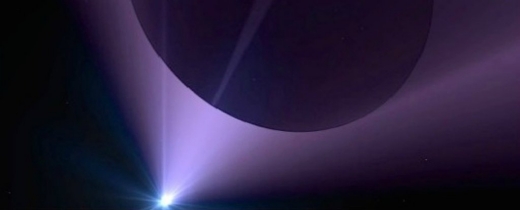
Paradigm: An creative person's conception of a laser-beamed sheet. Credit: Adrian Mann.
The Apr 2018 Breakthrough Committee Coming together
On April 11, the Starshot advisors met at a Breakthrough facility in the NASA Ames Infinite Flight Heart. While C displayed the prototype holographic message plaque, I presented the case for a holographic canvass. We learned that Harry Atwater of the California Institute of Technology and his team are investigating technologies that combine aspects of engineered metamaterials and holography. Most participants agreed that the idea of a holographic sail is promising. Some, including Avi Loeb of Harvard, suggested that experimental validation is required.
A number of experiments should be possible. Some of these could exist addressed in response to the Starshot Canvas RFP, which is scheduled for release in the nigh future. Jason Wentworth, a frequent contributor to Centauri Dreams, has informed me that projectiles fired by big naval guns routinely survive very loftier accelerations. A small thin-film hologram mounted on or in a suitable projectile might demonstrate whether a hologram can survive the requisite ~five,000 thousand acceleration.
It is non possible today to examination a holographic filter's reflectance and survival in a continuous ~50 GW light amplification by stimulated emission of radiation axle. But according to Wikipedia, the inertial-fusion confinement lasers at the National Ignition Facility located at Lawrence Livermore tin deliver 500 terawatts for a few picoseconds. Perhaps a test of a holographic sail could exist performed at that facility.
If a paradigm thin-movie holographic spherical filter or mirror is engineered to reflect in the microwave region rather than at the laser wavelength, another exam is possible using existing facilities. Beam-riding stability could be demonstrated using the equipment practical by Jim Benford, Greg Benford and colleagues to examine axle-riding stability of a number of sheet shapes during 2001 [11].
In whatsoever event, the situation is hopeful. Both C and I felt that we were channeling Bob Forrard during our presentation. It'south dainty to imagine that his shade is smiling and cheering on the efforts of the Project Starshot team.
References
one. P. Lubin, "A Roadmap to Interstellar Flight", JBIS, 69, forty-72 (2016).
2. Z. Manchester and A. Loeb, "Stability of a Light Sail Riding on a Laser Beam", arXiv:submit/1680014 [astro-ph.IM] 29 Sep 2016.
three. T. Hoang, A. Lazarian, B. Burkhart, and A. Loeb, "The Interaction of Relativistic Spacecrafts with the Interstellar Medium", arX1v: 1608.05284v1 [astro-ph.GA] a8 Aug 2016.
iv. K. Fifty. Matloff, G. Vulpetti, C Bangs and R. Haggerty, "The Interstellar Probe (ISP). Pre-Perihelion Trajectories and Application of Holography", NASA/CR-2002-211730, NASA Marshall Space Flight Center, Huntsville, AL (June, 2002).
5. R. Haggerty and T. Stanaland, "Applications of Holographic Films in Solar Sails", presented at STAIF-2002 Briefing, University of New Mexico, Albuquerque NM (January, 2002).
6. G. Fifty. Matloff, Deep Space Probes: To the Outer Solar Organisation and Beyond, 2nd. ed. Springer-Praxis, Chichester, UK (2005).
7. M. Irving, "Earth'south Thinnest Holograms Could Lead to Thin-Film 3C displays", New Atlas (May xviii, 2017).
8. W. Wang, "Reflection and Transmission Properties of Holographic Mirrors and Holographic Fabry-Perot Filters. one. Holographic Mirrors with Monochromatic Light", Applied Optics, 1994, May 1;33:2560-6. doi: x.1364/AO.33.002560.
nine. P. Sharlandjiev and Ts Mateeva, "Normal incidence Holographic Mirrors by the Characteristic Matrix Method", Journal of Optics, xvi, 185-190 (1985).
10. D. W. Diehl, "Holographic Interference Filters", Ph.D. Thesis, Constitute of Eyes, Schoolof Engineering and Applied Science, University of Rochester, Rochester, NY (2003).
11. James Benford, Gregory Benford, Olga Gornostaeva, Eusebio Garate, Michael Anderson, Alan Prichard, and Henry Harris, "Experimental Tests of Beam-Riding Sail Dynamics", Proc. Infinite Technology and Applications International Forum (STAIF-2002), Infinite Exploration Engineering Conf, AIP Conf. Proc. 608, ISBN 0-7354-0052-0, pg. 457, (2002).

Source: https://www.centauri-dreams.org/2018/04/20/holographic-sails-for-project-starshot-homage-to-bob-forward/
0 Response to "what makes you sail due west and come back to where you started on flat earth"
Post a Comment